
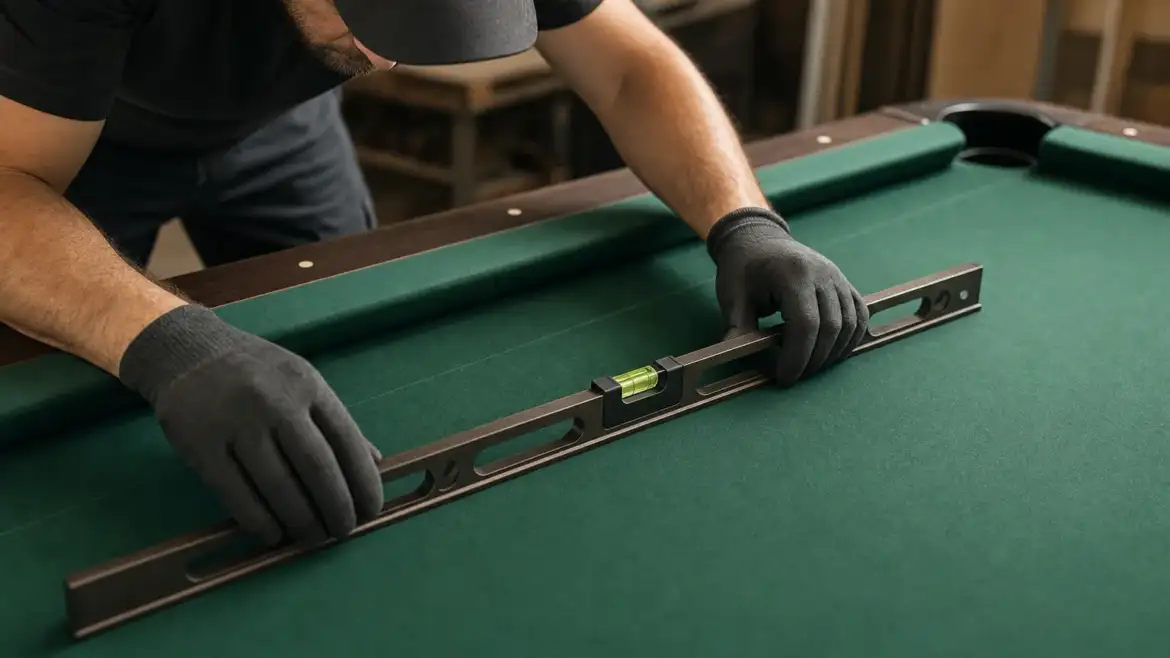
Getting a pool table perfectly level is one of the most important steps in ensuring consistent, professional-quality play. Whether you’ve just moved your table to a new location, purchased a pre-owned model, or are setting up a commercial venue, understanding pool table leveling tools and techniques will help you recognize what a properly leveled table looks like and when to call in professionals.
Why Pool Table Leveling Matters
A level table isn’t just about aesthetics. An unlevel playing surface directly affects ball roll, pocket alignment, and the fairness of every game. Even a slight slope can cause balls to drift toward one end of the table, throwing off bank shots, rail kicks, and straight shots. Tournament-standard tables must meet strict levelness requirements, and residential tables deserve the same precision if you want to enjoy reliable play.
Slate playing surfaces, which are used on quality tables, can shift over time due to house settling, temperature fluctuations, humidity changes, or rough transport. When you move a pool table, the slate bed may separate at seams or shift out of plane, making releveling essential after relocation.
Essential Pool Table Leveling Tools
Professional technicians use several specialized tools to achieve tournament-quality results:
Precision Bubble Levels
A high-quality machinist’s level, typically 24 to 48 inches long, allows technicians to check levelness across multiple points on the playing surface. The bubble must remain centered between the marked lines for true level.
Laser Levels
Modern laser levels provide rapid, accurate readings across long distances and are especially useful for checking diagonal levelness and identifying slopes that aren’t immediately obvious to the eye.
Feeler Gauges
These thin metal strips measure gaps between the slate and support frame, helping technicians identify exactly where the table is high or low and by how much.
Adjustable Leg Pads or Shims
Most pool tables have adjustable feet with threaded pads that can be raised or lowered. Shims, typically plastic or rubber wedges, are placed under frame rails to compensate for uneven floor surfaces.
Straightedges
A straight metal bar helps identify warping or curvature in the slate bed itself, which requires different correction strategies than simple levelness issues.
How Professionals Level a Pool Table
The leveling process follows a systematic approach that addresses both the table’s own structure and the surface it sits on.
Step 1: Assess the Foundation
Before working on the table, professionals evaluate the floor itself. Carpet, hardwood, tile, and concrete all affect how a table sits and where correction is needed. A floor that slopes toward a wall may require shims under multiple legs rather than adjustment of the table’s own feet.
Step 2: Check Lengthwise and Widthwise
Using a precision level placed along the length of the table, then across the width, technicians identify which direction the table slopes and by how much. This tells them which feet need adjustment.
Step 3: Measure Diagonal Points
A level table must be even across diagonals as well. Professional technicians check from corner to corner and across the center line to catch subtle high or low spots that might be missed with only lengthwise and widthwise checks.
Step 4: Adjust Strategically
Small adjustments to the table’s feet are made incrementally. Raising one foot too much can throw off the entire surface, so changes are usually made in 1/8 inch increments and rechecked frequently.
Step 5: Confirm with Finished Testing
After adjustment, a final check using a level, a rolling ball test (where a cue ball naturally returns to the center when released anywhere on the table), and visual inspection confirms the work is complete.
Common Challenges and Solutions
Uneven Flooring
Many homes and commercial spaces don’t have perfectly level floors. Rather than forcing the table’s feet to compensate, professionals use shims under the table frame to create a level surface for the slate bed to sit on.
Slate Seam Issues
On two-piece slate tables, the seam between the two halves must be level and flush. If one side is higher or lower, the ball roll will be affected right down the middle of the table. Seam work sometimes requires advanced restoration techniques.
Humidity and Temperature Effects
Wood frames expand and contract with seasonal changes. A table that plays perfectly in winter may develop minor levelness issues in summer. Professionals account for this and often re-level tables seasonally in climate-controlled environments.
Moving and Transport Damage
Improperly moved tables frequently develop levelness problems. This is why professional pool table moving services use specialized equipment to secure the slate during transport and releveling after placement.
When to Call the Professionals
While understanding leveling principles is helpful, achieving true tournament-quality levelness typically requires professional expertise and tools. DFW Billiard Professionals uses precision instruments and master-level table mechanics to ensure your table meets professional standards, whether it’s a family table or a commercial venue installation. After moving a table, releveling is nearly always necessary. Even small shifts in the slate bed during transport can throw off the entire playing surface.
When shopping for professional leveling services, look for technicians who not only adjust feet but also assess your flooring, check slate seams, and verify their work with precision tools. Clear communication about what they found and why certain adjustments were made shows a true understanding of the craft.
Professional Results You Can Trust
Pool table leveling requires the right combination of precision tools, methodical technique, and years of experience working with different table types, slate configurations, and installation environments. Getting it right the first time means enjoying consistent, fair play for years to come. If you’re in the Dallas-Fort Worth area and need professional leveling after a move or as part of table setup and installation, reach out to discuss your specific situation and get an accurate assessment of what your table needs.