
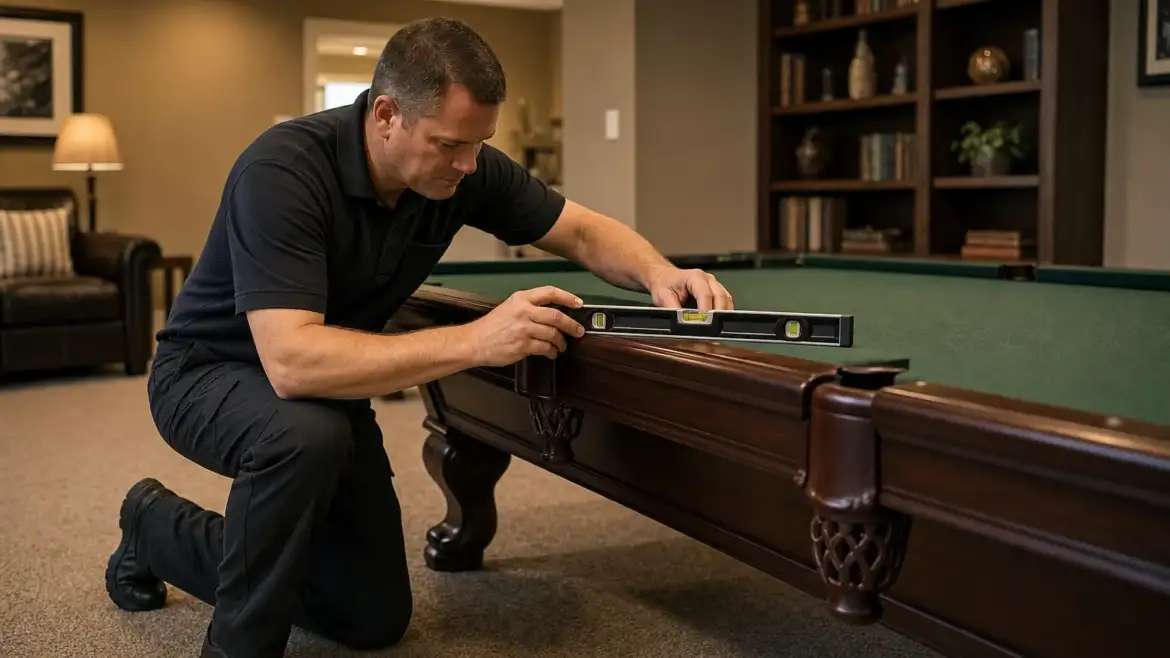
A pool table that plays straight on hardwood can roll crooked the moment it sits on carpet. If you have ever noticed balls drifting toward one end or rails that feel inconsistent, an unlevel table is almost always the cause. Carpet creates challenges that solid flooring simply does not, and understanding those challenges is the first step toward fixing the problem for good.
Why Carpet Complicates Pool Table Leveling
Hard floors give table legs a fixed, stable contact point. Carpet compresses under weight, and it does not compress evenly. Each leg of a pool table can sink a different amount depending on the carpet pad thickness, the fiber density, and where the furniture has already worn grooves into the pile.
The result is a table that was perfectly level when first installed but gradually shifts over weeks or months. Seasonal humidity changes make the situation worse by causing the carpet pad to expand and contract. Heavy tables, especially those with three-piece slate beds, can settle unevenly enough to cause noticeable ball roll problems within a few months of setup.
There is also a less obvious issue: because carpet hides the actual floor surface, small dips or high spots in the subfloor go unnoticed until they affect how the table legs sit. What looks flat from above may not be flat at all.
The Right Tools for the Job
Leveling a pool table on carpet is not a one-tool task. Professionals use a combination of equipment to get the slate bed true:
- Precision machinist level or digital level: A standard bubble level from the hardware store is not accurate enough. Pool table work requires a level that can detect fractions of a degree.
- Leg levelers or adjustable floor glides: Most quality pool tables include adjustable legs designed to compensate for uneven surfaces. On carpet, these glides need to be set carefully and checked after the table has had time to settle.
- Slate shims: Even with adjustable legs, the slate sections themselves may need shimming at the seams to eliminate any twist or bow across the playing surface.
- Carpet cups or floor protectors: These distribute the table’s weight over a wider area so individual legs do not continue sinking over time.
Without the right tools and the experience to use them correctly, a leveling job on carpet can look fine at first and fail within a few weeks.
Step-by-Step: How Professionals Level a Pool Table on Carpet
This is how a trained table mechanic approaches the job, not a DIY shortcut guide, but a clear look at what proper leveling actually involves.
- Inspect the existing setup. Before touching anything, the technician checks the current level in multiple directions across all three slate sections and notes where the high and low points are.
- Adjust the leg levelers. Starting with the lowest corner, the legs are adjusted so the table frame is roughly level. This is not the finish step. It is the starting point.
- Re-check the slate seams. On a three-piece slate table, each section must be level relative to the others. Even if the legs are right, uneven seams create a playing surface that will never roll true.
- Shim as needed. Thin metal or composite shims are placed under the slate where needed to eliminate any variation between sections. This step requires patience and multiple checks.
- Place carpet cups under each leg. These prevent further sinking and protect the carpet. Without them, the whole process may need to be repeated in a few months.
- Final level check. The mechanic checks the table in at least six positions across the full playing surface before calling the job done.
For anyone who wants to understand more about what a proper pool table setup and disassembly involves from start to finish, the process is more involved than most homeowners expect.
Common Mistakes That Lead to a Crooked Table
DIY leveling attempts on carpet often fail because of a few predictable errors:
- Using a short or inaccurate level that cannot detect subtle grade changes across a seven or nine foot surface
- Adjusting only the legs without checking the slate seams
- Skipping carpet cups, which allows legs to keep sinking after the job is done
- Not allowing the table to settle before making final adjustments
- Assuming the table is level just because a ball does not obviously roll to one end
A table can be slightly off-level and still appear to play fine to a casual observer. Over time, that slight variation creates wear patterns on the cloth, uneven cushion response, and frustration for anyone who plays regularly.
When to Call a Professional Instead of DIYing It
Some leveling situations are straightforward. If a table has simply settled a bit after a recent installation and the legs are adjustable, a homeowner with the right tools and some patience can often make a minor correction.
But there are situations where professional service is the smart call:
- After a move. A table that has been relocated and reassembled on carpet almost always needs professional leveling. The reassembly process itself introduces variables that require trained hands to resolve.
- When the table has three-piece slate. Aligning three separate slate sections correctly is a skilled task. Getting the seams flush and level without creating a ridge at the joints takes experience.
- When the table is a high-value or heirloom piece. Mistakes made during DIY leveling can damage slate, cloth, or the frame itself.
- When the problem keeps coming back. If a table goes off-level repeatedly, there may be a subfloor issue or a structural problem with the table that needs diagnosis.
DFW Billiard Professionals has handled pool table leveling across the Dallas-Fort Worth area for over eight years, including tables on carpet in residential game rooms, luxury estates, and commercial settings. The team uses professional-grade tools and knows how carpet and subfloor conditions interact with different table designs throughout North Texas.
If you have questions about what the process involves for your specific table, the pool table FAQ covers a wide range of common situations homeowners run into.
Getting the Level Right the First Time
A properly leveled pool table on carpet is not a temporary fix. When done correctly, with the right tools, proper shimming, and carpet cups in place, a table can stay true for years without needing adjustment.
The key is getting it right at the start. Whether your table was just moved into a new home, has been sitting unlevel for a while, or simply needs a professional checkup, DFW Billiard Professionals is equipped to handle it. The company serves homeowners and businesses throughout the entire Dallas-Fort Worth region and makes it easy to get accurate pricing and schedule service online without any back-and-forth. Reach out today and play on a table that rolls exactly the way it should.
FAQ
How often does a pool table on carpet need to be re-leveled?
It depends on the carpet type, pad thickness, and how much the table is used. Most tables on carpet benefit from a professional level check once a year, or any time ball roll becomes noticeably uneven.
Can I level a pool table on carpet myself?
Minor adjustments are possible if the table has adjustable leg glides and you have a quality precision level. However, three-piece slate tables and any table that has been recently moved should be leveled by a professional to ensure the seams are correct and the surface is true.
Do carpet cups actually make a difference?
Yes. Carpet cups distribute the table's weight over a larger surface area, which prevents individual legs from sinking further over time. They are an inexpensive addition that helps maintain a level table much longer.